
The PDA Newsletter | Darren Raddysh Case Study

What if the draft didn’t miss Darren Raddysh?
What if his best hockey showed up after the window closed?
There’s a line in Cal Newport’s So Good They Can’t Ignore You that can describe a lot of hockey careers.
Passion doesn’t create mastery.
Mastery creates leverage.
Newport’s point is simple: real career control isn’t granted early. It’s earned by stacking rare, valuable skills until opportunity has no choice but to show up.
Hockey has its own version of “career capital.”
It’s trust.
It’s being the player a coach can throw out after a mistake, on the second half of a back-to-back, or in a one-goal game, and not worry about what happens next.
His draft-eligible years came and went without his name being called.
So he was forced to take the hard road to make his game undeniable.
Let’s see how he got there…

The Part People Get Wrong About “Undrafted”
It’s easy to tell Raddysh’s story like it started when he didn’t get drafted.
That’s not really true.
The more accurate beginning is that he was already effective in junior, even before his “big year” made people look twice.
You don’t put up meaningful offense from the back end in the OHL by accident. You don’t keep producing year over year if you’re just riding hot streaks or getting carried by elite teammates.
His Erie progression tells you the arc:
2013–14: 13 points in 60 games
2014–15: 48 points in 60 games
2015–16: 40 points in 66 games
2016–17: 81 points in 62 games
The detail most people miss is the timing. His biggest season came in his overage year, after he’d already aged out of draft eligibility.
NHL scouts didn’t ignore an 81-point defenseman. They had already made their decisions earlier, when he was good, trending up, but not yet impossible to pass on.
That’s where Newport’s framework becomes useful.
The draft isn’t just a talent mechanism. It’s an investment mechanism.
When an organization spends a draft pick, they have an incentive to justify it. Development minutes follow investment. Patience follows investment. Mistakes get absorbed differently when there’s a sunk cost attached.
Undrafted players don’t have that luxury.
They get a murky spot within an organization’s depth chart and a short leash.
If Newport calls this the difference between chasing passion and building your craft, hockey calls it something simpler: you either earn trust, or you keep moving.
Raddysh didn’t have the trust in his game at this point in his career so he was forced to keep moving and keep developing.

339 Games of Proof
If you want the real story, it isn’t the 81-point season in Erie where he won the Max Kaminsky Trophy as the league’s top defenseman and the Leo Lalonde Trophy as the top overage player.
It’s what came after, in six long AHL seasons away from the spotlight.
The AHL is pro hockey. It’s the closest thing to the NHL grind you can live in every night. The pace is real. The mistakes are costly.
For Raddysh, it wasn’t a quick developmental stint along the way to the NHL.
It was something far more grueling and challenging.
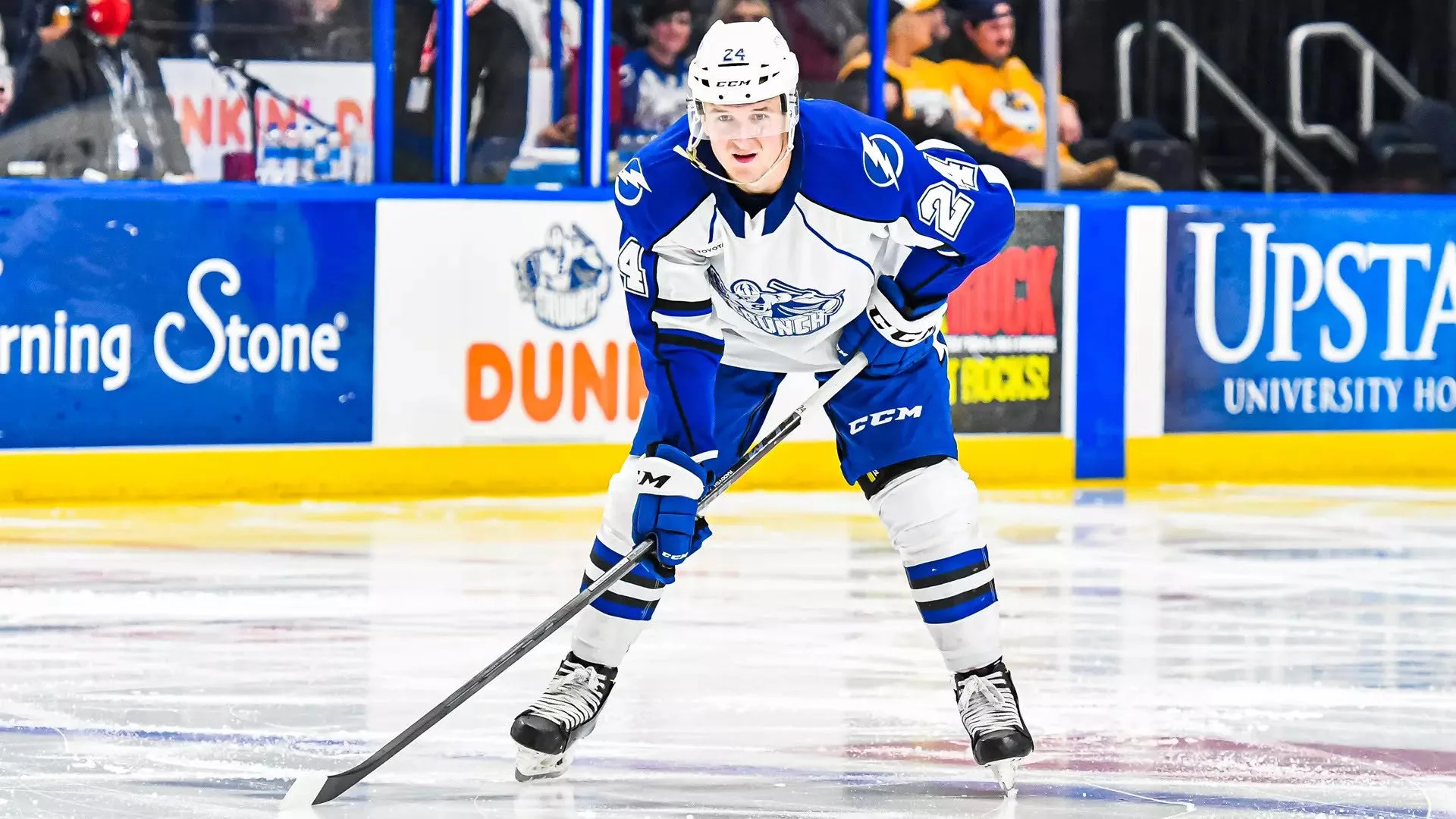
It was 339 regular-season AHL games across three organizations. Rockford. Hartford. Syracuse. Two of those stops ended with the organization moving on.
That detail matters because it’s the opposite of job security. New partners, new systems, new coaches, new expectations. You learn the structure in September and you’re expected to execute it by October. There’s no long runway to “find your game.” You either play well enough to earn your minutes, or they go to someone else.
In a professional environment like that, your first bad read shows up on video the next morning. A rough stretch shrinks your role fast. When a first or second-round pick needs minutes, those minutes appear. Someone else sits.
That’s why the AHL isn’t just a developmental league.
It’s a league with clear asset hierarchy.
Newport calls the output of that environment career capital: rare and valuable skills that eventually buy you leverage. In hockey terms, it’s the slow accumulation of trust through repeatable details.
That’s what Raddysh was forced to build in the minors for years.
Not a flashy identity. Not a one-trick calling card. A set of decisions and habits that travel anywhere:
first passes that relieve pressure instead of extending it
gaps that force dumps instead of clean entries
blue-line reads that end cycles early
shifts that don’t tilt momentum the wrong way
339 games isn’t just “seasoning.” It’s more accurately described as constant exposure. Undeniable reps. Enough time for volatility in your game to disappear or define you. Enough time to eliminate the mistakes that get you stapled to the bench.
This translates at every level.
Every shift you remove chaos, you build capital in your favour.
Not just in theory, but in the only currency that matters in hockey.
The Turning Point
Every good story has a moment where the script changes in the main character’s favour.
For Raddysh’s story, it wasn’t a dramatic quote or a viral highlight that got him all the attention.
It was production that became too loud to dismiss in a league full of grown men fighting to keep their jobs and earn their shot at the NHL.
In 2022–23, he put up 51 points in 50 games in the AHL.
That’s the kind of season that forces a serious decision from above. Not because points are everything, but because when a defenseman produces like that while still playing a well-rounded, pro-game, the organization can’t pretend it’s not relevant.
Raddysh had unofficially arrived.
This is where Newport’s thesis becomes the spine of the story.
The career capital had been accumulating for years. That season wasn’t the beginning. It was the moment the Raddysh’s stock finally looked too valuable to keep off the main market, or in hockey terms, the NHL.
Once you stack enough proof, you stop asking for an opportunity.
The opportunity starts responding to you.
He’s been an NHL regular since.
The Arrival
Here’s what people miss about “making it.”
Getting to the NHL is the hardest part. Staying there as more than a fill-in is the real separator.
In the NHL, trust shows up as workload: more minutes, tougher matchups, more defensive-zone starts, and more situations where the staff leans on you.
Raddysh is living in that world now.
This season, he’s taken a real jump: 55 points in 54 games, including 17 goals, while logging 22:38 a night on what has been, for the majority of the season, a depleted Tampa blue line.
This jump also didn’t come out of nowhere. He spent the two seasons before this as an NHL regular with the Lightning, putting up 33 points in 82 games and 37 points in 73 games.
This is the part that completes the arc.
The undrafted player who once had no insulation around his stock now carries real minutes and responsibility for one of the best teams in the NHL.
That doesn’t happen because someone finally “believed.” It happens because his game became stable and repeatable under pressure, and the coaching staff can deploy him with confidence.
If the AHL phase is career capital, the NHL phase is control following capital.
Newport’s rule holds.
Minutes follow trust.
Trust follows repeatability.
Repeatability follows craft.
And craft, given enough time, becomes unwavering leverage that no one can take away.
The Player He’s Become
Here’s the cleanest way to say it:
He built a pro game that travels, then proved it long enough that the league will be forced to price his value correctly.
He’s doing all of this on $975K, and he’s heading into a new contract. A defenseman playing 22-plus minutes and producing like this doesn’t stay under a million for long. His next deal will reflect his current role.
That’s the full Newport arc in hockey form:
Craft first.
Career capital next.
Control after.
Concluding Thoughts
So what actually changed for Darren Raddysh?
Not his desire. Not his passion. Not his dream.
What changed was the weight of his craft.
He stayed in pro hockey long enough, built enough career capital, and stacked enough proof that the NHL had no way to keep him out any longer.
He became so good they couldn’t ignore him anymore.
What Players Can Learn From Raddysh
The draft isn’t a deadline on your development.
Some players separate later. Your job is to keep stacking skill until your play forces opportunity.
Coaches don’t bench effort. They bench risk.
Cut the plays that burn you: blind middle passes, soft chips into pressure, low-percentage holds at the blue line.
Trust shows up as minutes, not compliments.
When your shifts stay clean, you earn tougher matchups, late-game shifts, PK time, and more responsibility.
Your role grows when your game is repeatable.
The fastest way to move up a lineup is to play the same reliable game on Tuesday night as you do on Saturday.
Actionable Advice
If you want more minutes and more control in your output, build career capital. In hockey, that means trust you can cash in every night.
Build your game around habits that keep you on the ice in all situations. The rewards might not be seen instantly, but your body of work will scale accordingly as your game develops.
Talon Mills
